
Contributed by Animesh Pathak, Harness
Database delivery is the most fragile part of modern release pipelines and the least automated. While application teams ship dozens of times a day using modern CI/CD workflows, database changes still move through tickets, manual approvals, and tightly controlled release windows. This gap has real consequences: delayed features, high-risk deployments, weekend rollouts, and growing tension between developers and database teams.
The root problem has never been Kubernetes adoption. It has been trusted. Schema changes are irreversible, tightly coupled to data integrity, and difficult to roll back. As a result, organizations optimized for safety by slowing everything down at the cost of delivery velocity and operational clarity.
That tradeoff is no longer necessary. A new operating model is emerging where database changes follow the same disciplined, version-controlled workflows as application code. By applying GitOps principles to schema delivery using Git as the source of truth, pull requests as approval gates, and automated deployment workflows as the execution mechanism, teams can introduce automation without sacrificing governance. The sections that follow break down how this model works in practice, what architectural patterns make it safe, and how platform teams are adopting it at scale.
Why GitOps and CI/CD Workflows for Databases Make Sense
GitOps provides a natural operational model for database delivery by standardizing how schema changes are proposed, reviewed, and executed. Kubernetes is a common execution platform, but the same principles apply to managed and self-hosted databases.
Most teams already rely on migration tools such as Liquibase, Flyway or SQL to define and order schema changes. GitOps complements these tools by making Git the source of truth for delivery:
- Version control of desired state
- Policy and approval workflows built into pull requests
- Automated reconciliation for promotion across environments
- Consistent execution across clusters and namespaces
The goal is not to containerize database engines by default. Many organizations continue to use managed services such as Amazon RDS or Google AlloyDB. Kubernetes instead acts as the orchestration layer for schema evolution, determining when and where Liquibase or Flyway migrations run. Deployment platforms build on this pattern by integrating existing migration tools with GitOps workflows, adding governance, policy enforcement, environment promotion, and execution controls. The result is a unified delivery model where databases follow the same operational principles as applications, without introducing bespoke pipelines or manual handoffs.
The GitOps Architecture Behind Database Deployments
This model works because it aligns three foundational components, each with clearly defined responsibilities and failure boundaries:
1. Persistence Layer – Whether the database runs inside Kubernetes or is externally managed, data persistence is decoupled from the pod lifecycle. Persistent volumes, external storage backends, and managed database services ensure that schema execution does not introduce data volatility. Kubernetes orchestration never owns the data, it only coordinates access to it.
2. Migration Execution Layer – Schema changes are executed through automated deployment workflows rather than manual intervention or application startup routines. These workflows may be orchestrated by CI/CD platforms, GitOps controllers, or Database DevOps solutions.
Effective execution layers provide:
- Retry and rollback mechanisms
- Clear success and failure states
- Auditability and traceability
- Separation from application deployment lifecycles
Database Schema Migration tools continue to enforce ordering, version tracking, and idempotency, ensuring schema changes are applied consistently across environments.
3. GitOps Layer – Git is the source of truth for what should be applied and where. GitOps controllers such as Argo CD or Flux detect approved changes and trigger the corresponding migration jobs in the target environment, cluster or namespace.
Promotion across environments follows a branch strategy rather than manual intervention:
- Development → staging → production
- Each promotion is explicit, reviewable, and repeatable
If a migration fails, reconciliation halts. No partial rollout continues silently. This behavior aligns with Kubernetes’ declarative model while respecting the irreversible nature of schema changes.
This architecture avoids over-abstraction while eliminating operational friction. Schema changes remain explicit, reviewable, and backed by automation.
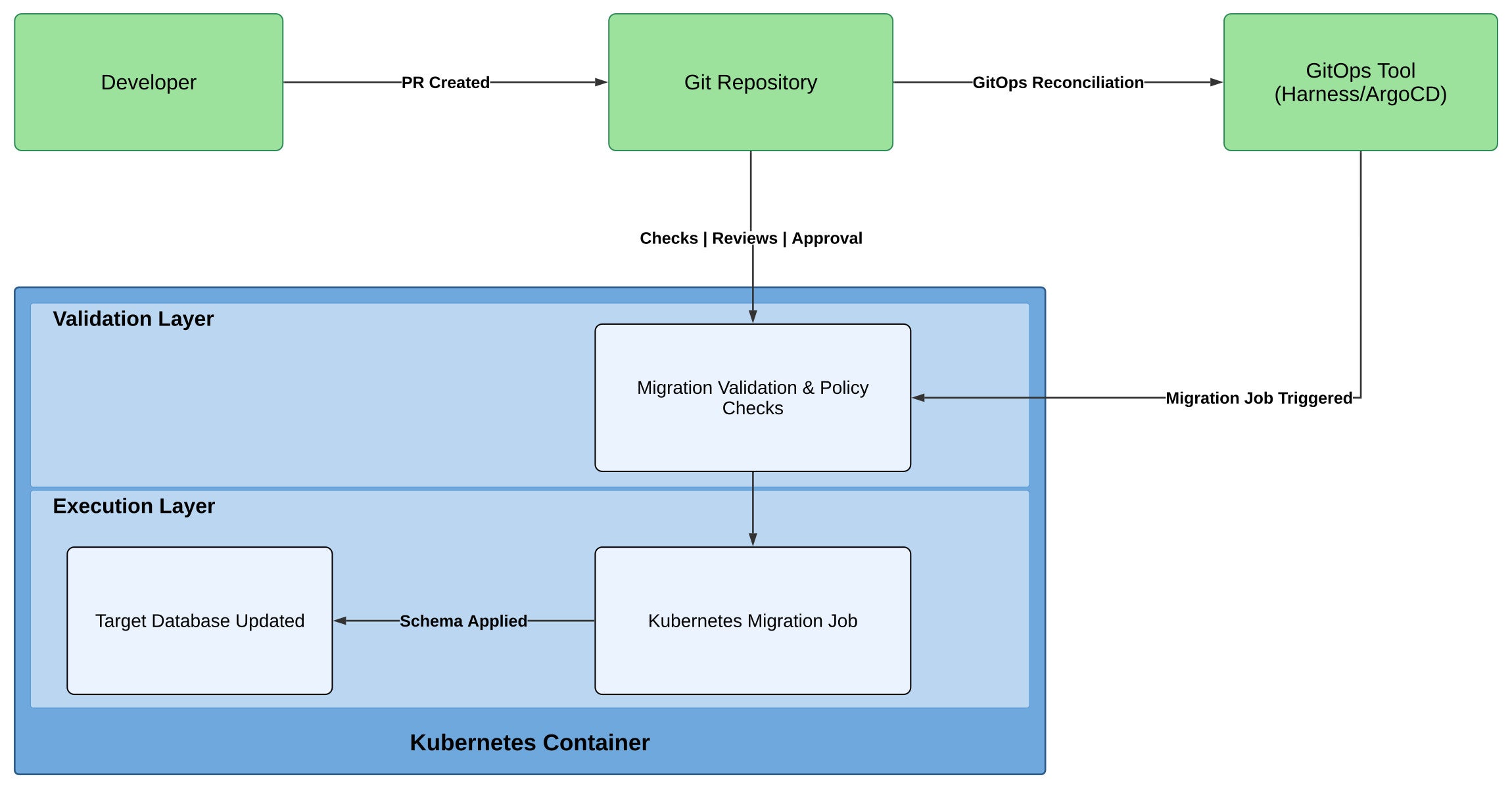
The process in practice:
Consider a simple schema change: adding a new column to an existing table using CI/CD.
- Pull Request – A developer adds a new migration file (for example, V12__add_order_status.sql) to the database repository and opens a pull request. Automated checks validate SQL syntax, enforce policies, and optionally run the migration against a temporary test database.
- Approval and Merge – Once reviewed and approved, the pull request is merged. At this point, Git reflects the desired database change for the target environment, nothing has been applied yet.
- GitOps Sync – A GitOps controller (such as Argo CD or Flux) detects the new commit and reconciles the target Kubernetes environment based on the updated repository state.
- Migration Execution – Following approval, the deployment workflow executes the approved database migration using tools such as Liquibase or Flyway. Execution may be orchestrated through CI/CD pipelines, GitOps controllers, or Database DevOps platforms, depending on organizational standards. The migration process is isolated, observable, and fully auditable, with execution logs, deployment records, and change history captured throughout the lifecycle.
- Post-Execution Validation – Application readiness checks confirm compatibility with the updated schema. If the migration fails, the rollout stops and no further promotion occurs. The entire change from PR to execution is traceable through Git history and Kubernetes events.
Organizations can implement these workflows using open-source tools such as Liquibase, Flyway, Argo CD, and Flux. Database DevOps platforms build on these foundations by adding governance, policy enforcement, and operational capabilities for larger teams.
Conclusion
Modern database delivery no longer needs to be separated from the practices that have transformed application delivery. By applying GitOps and CI/CD principles to schema management, organizations can create repeatable, auditable, and policy-driven deployment workflows without compromising governance or data integrity.
The underlying execution platform may vary, but the core principles remain the same: database changes are version-controlled, validated through automated workflows, reviewed through established approval processes, and promoted consistently across environments.
GitOps does not replace established database migration tools, instead it provides a consistent operational model around them. By combining Git as the source of truth, pull requests for governance, GitOps controllers for reconciliation, and migration frameworks for execution, organizations can manage database changes with the same repeatability, visibility, and confidence already expected for application deployments.