
Recorders, paper planes, and a model from DORA
Contributed by Steve Fenton, Octopus Deploy
With AI headlines awash in success stories as well as massive failures, how do you make sure the money you spend leads to benefits, not disaster? Well, DORA has published a new paper that draws on their recent AI-assisted software development research and views it through the investment lens, so it may answer this crucial question.
The Unavoidable J-Curve
Imagine your least favorite niece or nephew has decided to learn the recorder. They have been sent home from school with their newly assigned instrument, and their parents have tried to wash the second-handness off it.
What happens next is their first attempt to make a note. They don’t create a note; it’s more of a screech, but it’s their first go. Their second and third attempts are equally displeasing, and so it continues for some time.
You are living through the J-curve. Like a paper plane dropping from a height, you’re hoping to see it catch the air and tilt upwards, gaining more altitude as the wind catches its wings. Yes, we now have two metaphors that will help us build this AI story: the recorder and the paper plane.
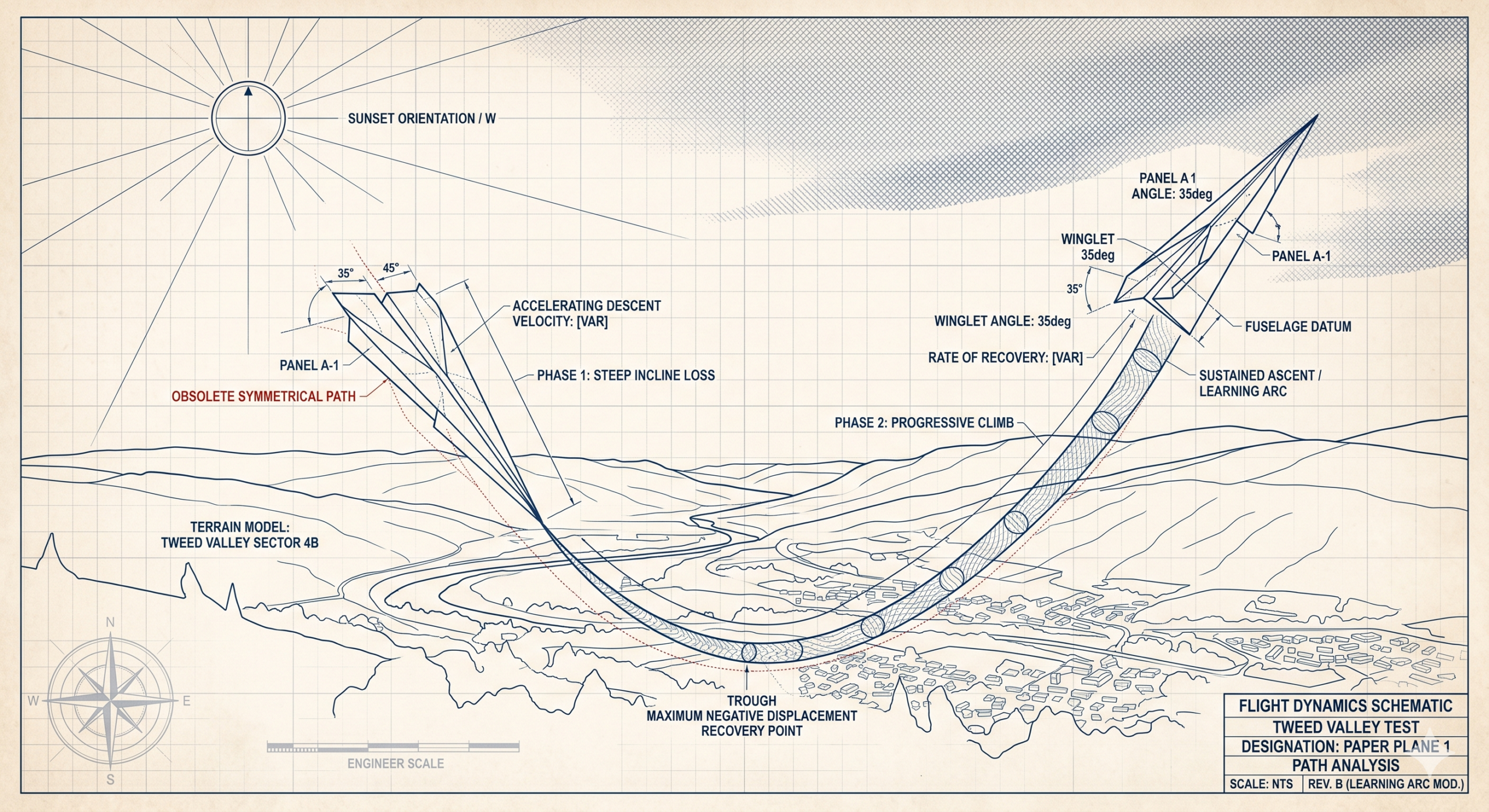
So, life was better before your youthful relative started learning the recorder. Now it’s worse. Often much worse. As tempting as it is to snatch the recorder and pitch it into the river, you know that, given some time, their playing will reach a level that means it’s no longer making you miserable.
As they continue and improve their skill, you may even enjoy their playing. When they band together with their siblings and release a hit folk-pop record, you’ll think back fondly on that process of skill development. You might tell people: “I never really hated it anyway.”
AI Screeches Before It Sings
When your organization starts introducing AI, there will be some bad notes. Developing the taste to distinguish good from bad notes is crucial; then, fixing the bad notes with practice will come naturally.
On top of the tool cost, the AI learning curve, the verification tax, and pipeline adaptation all push the initial J curve below the break-even line. The longer you spend below that line, the longer it takes to pay back that investment. That means you want to set up the conditions for success before pushing hard on AI.
This is where the first cautionary tale arrives. Some organizations are breaking out of the dive, while others never regain altitude.
You don’t get good at the recorder by blowing harder, and you don’t get good with AI by pushing adoption harder. Instead, you need to create the conditions for success. In the report, DORA describes it like this:
“Artificial intelligence (AI) serves as a powerful amplifier in software development. It magnifies the strength of high-performing organizations and the dysfunctions of struggling ones.”
For organizations hoping to increase the delivery of value through software, the route to success involves setting the right foundations before adding AI. That’s a mix of organizational culture, the right kind of leadership, and technical practices that ensure value flows from development teams to users. We might label this “Continuous Delivery”.
DORA’s Value Framework
AI adoption enters the DORA value model from the left. This is the added ingredient that you hope will make your cake delicious. All the way to the other side of the model are the financial returns you get from adding AI. Things like business growth (more money coming in) and cost efficiency (less money going out).
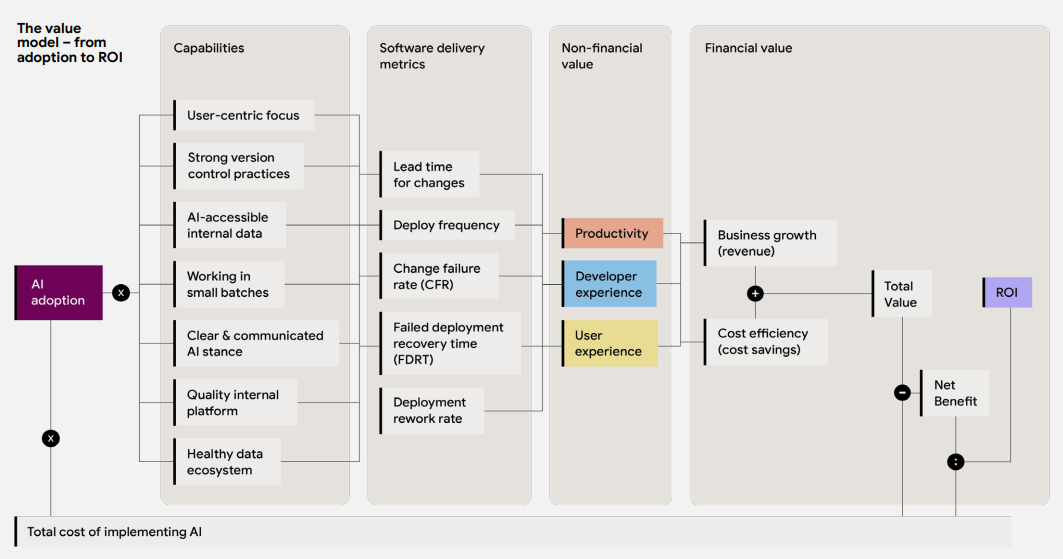
Source: DORA
In simple terms, whatever it costs to put AI in one end needs to result in more financial value at the far end for AI adoption to be successful. This shouldn’t be controversial, but with many organizations measuring AI adoption by activity metrics, like lines of code changed, pull requests, or features delivered, it may be.
Now, the paper has plenty of valuable detail on all of the model’s elements, but you might be eager to see some numbers. If that’s the case, DORA has created an ROI calculator for you to see the potential returns. Just remember that this depends on you having in place the capabilities that make you a magnifier of goodness, not a critical mass of dysfunction.
To get the most from the ROI calculator, form a team around it and fill it out together. The conversations you have as you answer each question will be even more valuable than obtaining a “first-year benefit” in dollars.
Find Out More
Read the ROI of AI-assisted software development to understand the methodology behind the model and refer back to the value model diagram to check what might be missing from your organization.
You can also share what you learn as you navigate the J-curve with the CD Foundation Community, where we’re highly interested in how AI can be an accelerator for software delivery.