Contributed by Kate Scarcella
In modern software delivery, speed without security is a false economy. Every commit, container, and deployment represents a potential point of compromise; yet it’s also an opportunity to embed trust.
The CI/CD Security Blueprint for Open Source Tooling helps teams visualize how open source tools, modern frameworks, and continuous validation converge to build resilient, transparent software pipelines.
The Problem We’re Solving
Most pipelines are built for velocity, not veracity. Developers commit code quickly, builds trigger automatically, and deployments run within minutes — but too often, verification trails are incomplete or nonexistent. The blueprint addresses that gap by making security visible, measurable, and repeatable across three critical phases of the Continuous Integration/Continuous Delivery (CI/CD) lifecycle.
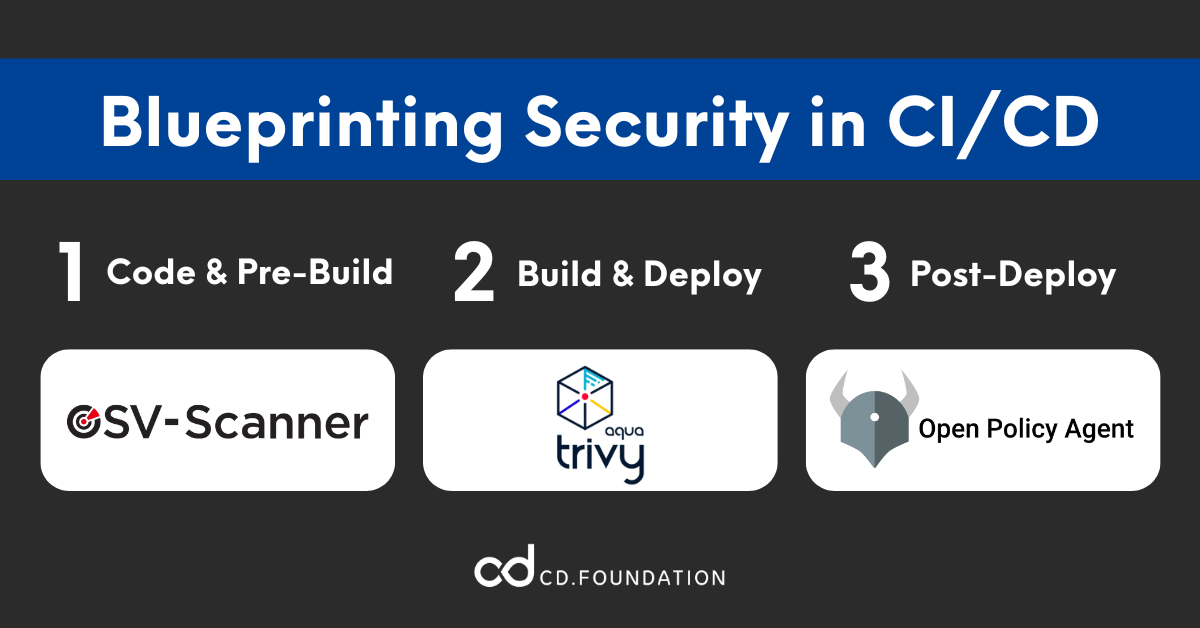
(This set of tools is only an example, you can use other tools. Check out our Cybersecurity Guide for more.)
Phase 1: Code and Pre-Build
Security begins long before the first build. This phase focuses on the source of truth: code, dependencies, and configuration. Teams can scan repositories for vulnerabilities and secrets before merging, analyze code for unsafe patterns or outdated dependencies, and generate an early Software Bill of Materials to establish dependency visibility.
Open source tools such as Semgrep and OSV-Scanner make these practices accessible and automatable. When integrated directly into pull requests or pre-commit hooks, they ensure unsafe code never reaches the build stage. This is where security truly shifts left…catching issues before they can propagate downstream.
Phase 2: Build and Deploy
Once code is merged, trust must be constructed. The build and deploy phase verifies both what is being built and how it is being built. Artifacts should be scanned, signed, and accompanied by provenance data and attestations.
Tools like Trivy, Cosign, and Open Policy Agent (OPA) support this process. Trivy identifies vulnerabilities in containers and artifacts, Cosign ensures each build is cryptographically signed, and OPA enforces the rules that govern what can be promoted or deployed. Together, they produce verifiable outputs: every artifact can prove its origin, composition, and integrity.
Phase 3: Post-Deploy
Security doesn’t end at deployment; it evolves. Once code runs in production, new data becomes the input for securing the next release. Teams can monitor workloads for anomalies, detect configuration drift in real time, and feed those findings back into earlier stages.
Open source tools such as Falco and OPA extend visibility into runtime behavior. Post-deploy monitoring closes the loop between development and operations, turning detection in one release into prevention in the next.
The Role of Platform Engineering
Platform engineering has become the connective tissue between development, operations, and security. Instead of forcing each team to assemble its own CI/CD pipeline, platform engineers create secure, reusable blueprints…pre-built paths that integrate open source tooling and policy by default.
In practice, platform engineering operationalizes the CI/CD Security Blueprint. Code and Pre-Build controls such as Semgrep and OSV-Scanner are built into the developer experience. Build and Deploy gates for scanning, signing, and policy enforcement are standardized within shared pipelines. Post-Deploy monitoring through Falco and OPA is unified under centralized observability systems.
This model transforms security from a checklist into a platform capability. Developers move faster not because guardrails are removed, but because trust is built into the environment itself. Platform engineering turns the blueprint into infrastructure; something consistent, observable, and scalable across teams.
Continuous Validation: The Living Loop
Beneath the three stages runs the engine of continuous trust: evidence, attestations, SBOMs, and monitoring. Each build, deployment, and runtime event generates artifacts that verify the software’s integrity. Together, these form a cycle of continuous validation, not a one-time audit but a living feedback loop between tools, frameworks, and teams.
Security evidence becomes a language that development and compliance can both understand.
Framework Alignment
The blueprint naturally aligns with frameworks such as the NIST Secure Software Development Framework (SSDF), NIST CSF 2.0, and the EU Cyber Resilience Act (CRA). Instead of referencing them as checkboxes, the blueprint translates their principles into daily automation. For example, identifying dependencies corresponds to running OSV-Scanner; protecting artifacts aligns with signing them through Cosign; and monitoring workloads is realized through Falco.
Policy statements become actions, and compliance becomes measurable and verifiable by design.
A Culture Shift in Security
This approach is not about adding more tools but about designing security as an architectural layer that developers can see, trust, and extend. In open source, transparency is a strength. When every phase of the CI/CD process is observable and verifiable, trust becomes a measurable quality rather than a promise.
Discover other tools that could work for you and your organization in our full CI/CD Cybersecurity Guide.